
News
Scottish Government staff mark Hospice Care Week
 On
Thursday 10th October, the Scottish Government offices at St Andrew’s House in Edinburgh were
visited by Before I Die – a
global public art project that invites people to reflect on their lives and
share their personal aspirations in public space.
On
Thursday 10th October, the Scottish Government offices at St Andrew’s House in Edinburgh were
visited by Before I Die – a
global public art project that invites people to reflect on their lives and
share their personal aspirations in public space.
Good Life, Good Death, Good Grief and the 100% Project brought the Before I Die walls to St Andrew’s House to mark Hospice Care Week 2013.
Before I Die was originally conceived by American artist Candy Chang, who explains on her website the inspiration behind the project: “After I lost someone I loved very much, I thought about death a lot. This helped clarify my life, the people I want to be with, and the things I want to do, but I struggled to maintain perspective. I wondered if other people felt the same way. So with help from old and new friends, I painted the side of an abandoned house in my neighborhood in New Orleans with chalkboard paint and stenciled it with a grid of the sentence ‘Before I die I want to _______.’ Anyone walking by could pick up a piece of chalk, reflect on their lives, and share their personal aspirations in public space.”
Rebecca Patterson, from Good Life, Good Death, Good Grief, said: “At Good Life, Good Death, Good Grief we believe that problems are caused in Scotland because as a society we are reluctant to be open about death, dying and bereavement. For example, people are unprepared for the experiences of death, dying and bereavement. Communities can be disempowered from providing support to people who are dying or bereaved. Health and social care professionals are unprepared for death-related discussions.
 “We believe that many of these problems can be
solved by raising public awareness of ways we can all support each other
through the difficult times that come with death, dying and bereavement. Before
I Die walls are a meaningful and light-hearted way of bringing reflections
on life and death into public spaces.”
“We believe that many of these problems can be
solved by raising public awareness of ways we can all support each other
through the difficult times that come with death, dying and bereavement. Before
I Die walls are a meaningful and light-hearted way of bringing reflections
on life and death into public spaces.”
Hospice Care Week is held each year, as a week of celebration and action aimed at changing people's perceptions of hospice care, and to help raise the profile of hospice care across the UK.
Ali Kerr, Fundraising Manager at the Children’s Hospice Association Scotland added: ““CHAS understands that families who experience the death of a child experience isolation and stress through society’s reluctance to talk about death and dying. CHAS has a responsibility to play a part in helping to challenge these issues in the hope that this will make communication with and for families a little bit easier. That is why we set up the 100% Project, which aims to start conversations about death, dying and bereavement in a life-affirming way.”
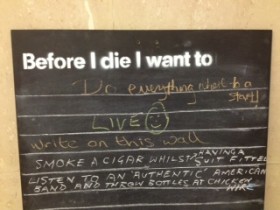
So, what to St Andrew's House staff want to do before they die? Suggestions ranged from the practical “Before I die I want to retire” to the romantic “Before I die I want to find true love” to the whimsical “Before I die I want to smoke a cigar whilst having a suit fitted.”
MSPs recognise the need to be open about death
Seven MSPs voiced their support for more openness about death, dying and bereavement during a recent debate in the Scottish Parliament.
Nanette Milne MSP, whose parliamentary motion initiated the debate at Holyrood, said "the Scottish taboo around talking about death should be tackled". She also highlighted the importance of early identification, assessment and treatment of pain and the associated physical, psychosocial and spiritual problems, and the essential role palliative care plays in this.
 MSPs from across all parties agreed that openness is essential in
creating a society where people can discuss their needs and preferences for
care towards the end of their life.
Michael McMahon, MSP for Uddingston and Bellshill said: “I believe that Scottish society would benefit from being more
open to death, the dead and dying, and that we would become more aware of the
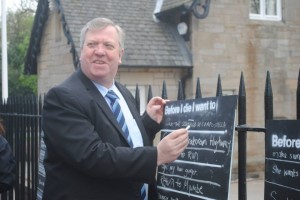
options and choices that are available when we are faced with the end of life.” Pictured (right) is Michael McMahon MSP taking part in Good Life, Good Death, Good Grief awareness week earlier this year, by writing on a Before I Die wall outside the Scottish Parliament.
MSPs from across all parties agreed that openness is essential in
creating a society where people can discuss their needs and preferences for
care towards the end of their life.
Michael McMahon, MSP for Uddingston and Bellshill said: “I believe that Scottish society would benefit from being more
open to death, the dead and dying, and that we would become more aware of the
options and choices that are available when we are faced with the end of life.” Pictured (right) is Michael McMahon MSP taking part in Good Life, Good Death, Good Grief awareness week earlier this year, by writing on a Before I Die wall outside the Scottish Parliament.
Neil Findlay, Lothian MSP, brought a personal note to the debate, reflecting on his experiences of the death of his father: “Scots are not very good at dealing with these types of things. Death is a time that brings out the best and worst in people. Often, we do not like dealing with all the practicalities surrounding death, expressing our emotions and taking time to look at the practical steps that we need to take. We do our best to avoid those things until we have to do them. We do not tell the people who are closest to us simple things such as how much we love them until it is too late.”
This debate was prompted by the publication of research which asked the question How good is primary care at identifying patients who need palliative care? Published in the European Journal of Palliative Care, the paper is the result of a study led by Prof. Scott Murray and Dr Lilin Zheng at the University of Edinburgh in collaboration with representatives from Marie Curie Cancer Care, and NHS Lothian.
The key findings of the study were that:
- Only 20% of patients with chronic heart, lung, liver or kidney conditions (organ failure) or dementia, either requested or were identified for palliative care before dying.
- 75% of cancer patients were identified for palliative care before dying.
- Most patients who were identified for palliative care received it too late to fully benefit – on average only 8 weeks before dying.
- GPs said that identifying patients for palliative care was fairly straightforward for those with cancer, who typically had a clear terminal phase.
- GPs generally found it difficult to discuss death and dying with patients, particularly with patients with a non-cancer diagnosis.
- Few patients openly discussed that they might die, thinking that this was a negative thing to do, although doctors thought it to be helpful for all concerned.
- Negative connotations associated with and a lack of understanding around terms such as ‘palliative’ and ‘hospice’ were also recognised as barriers for starting palliative care and support.
Reflecting on the research, Jim Hume, MSP for South Scotland emphasised the role of GPs: “One of the more enlightening areas of the research was the views of the health professionals. It is clear that GPs across Scotland are having real difficulty in identifying which non-cancer patients are appropriate for palliative care. They are also having difficulty in discussing death and dying with non-cancer patients with life-threatening conditions.”
Malcolm Chilsholm, Edinburgh Northern and Leith MSP drew attention to Good Life, Good Death, Good Grief, saying: “The good life, good death, good grief campaign highlighted in the
motion not only supports those going through the death and grieving process but
seeks to normalise that process and open up conversations on the surrounding
issues. Like the report, the campaign points out that it is never too early to
think about planning ahead for illness and death and that making plans when we
are healthy means that the pressure of making crucial decisions is lessened at
the point when sickness takes hold.”
Paisley MSP George Adam added his support for Good Life, Good Death, Good Grief, saying: “We need to ensure that more people know about that initiative so that,
when other families are in that type of position, they do not have to go
through the same difficulties.”
The Minister for Public Health, Michael Matheson MSP welcomed the research and reiterated the government’s recognition of the need for good palliative care to be provided in all care settings, on the basis of need rather than diagnosis. Recognising the need for openness about death, dying and bereavement, he said: "... none of the issues will be addressed quickly or easily. Individuals often have a natural aversion to talking about dying and death. Some good work has been undertaken, which members are aware of, through the good life, good death, good grief programme. We need to build further on that to allow those discussions to take place.”
Dining with Death at the Fringe
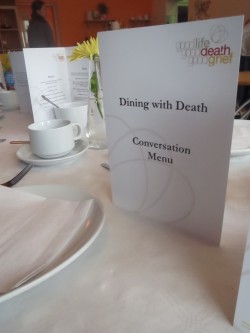 This August saw the first ever Dining with Death events held at the Edinburgh Fringe, giving people the opportunity to chat to interested strangers in a light-hearted manner about death, dying and bereavement.
Around 40 people attended the two events, where diners worked their way through the Dining with Death Conversation Menu. People tackled topics such as 'Is there really a taboo about death, dining and bereavement in Scotland?'; 'What things do you think make for a 'good death'?' and 'How would you like to be remembered?'.
The conversation menu was accompanied by a three-course meal of traditional Sikh funeral food provided by Punjabi Junction, a community café set up to empower Sikh and other ethnic minority women and their families. The events were co-facilitated by Good Life, Good Death, Good Grief and the 100% Project, a community engagement project which aims to start conversations about death, dying and bereavement in a life-affirming way.
 The popularity of the events challenges the notion that people in Scotland are reluctant to talk about death. In the words of some participants:
"Wonderful! Great tea, great food - I loved it!"
"I realised how much I love life, what I love about it and what I need to do to make it more vivid for now."
"Amazing! Please keep going!"
The two events - billed as Tea, Cake or Death? Death Cafe - were part of the Just Festival, which aims to provide a platform for people to explore their own spirituality by engaging with other people's to promote peace.
Talking about death over food is a growing trend. In Europe and the US, there is a thriving Death Café movement, where people "come together in a relaxed and safe setting to discuss death, drink tea and eat delicious cake". In the USA, the recently established Death over Dinner project hopes to create communal dialogues around death, healthcare and human life.
 The Dining with Death conversation menu was used for the first time at the launch of Good Life, Good Death, Good Grief in November 2011. Sixty people with various interests and backgrounds were invited to Howie's Restaurant in Edinburgh to experience first hand the positive effects of talking about death with strangers. Since then the menu has also been used at education events for NHS professionals, and to facilitate family discussions about end of life wishes.
Rebecca Patterson, Policy & Communications Manager at Good Life, Good
 Death, Good Grief said:
"At Good Life, Good Death, Good Grief we believe that problems are caused in Scotland because people are unprepared for the experiences of death, dying and bereavement and don't know how to support each other through these difficult times.
"Talking about and being open about these issues can help. The Dining with Death menu was designed to act as an inspiration and an ice-breaker - to give people
 permission, and help people get started on what is often perceived as a taboo subject.
"The atmosphere at Tea, Cake or Death? was friendly, warm and welcoming - people were enjoying themselves. Everyone has their own story to share - their own thoughts, feelings, concerns and experiences. Perhaps what we lack in Scotland isn't the willingness, but the right opportunities to talk about death."
Aberdeen opens up
A group of individual members of Good Life, Good Death, Good Grief from Aberdeen got together at the Bon Accord Centre on Sunday 18th May 2013 armed with a Before I Die wall, lots of information for people to take away, and time to talk and listen.
Vanessa Smith, Humanist Celebrant and member of GLGDGG said:
-300.JPG) "We had been warned that the people of the
North East of Scotland would not be open to even thinking about, never mind
talking about, end of life issues. What we found flew straight in the face of
this and we had the most profound, moving, funny, deep, beautiful, sometimes
painful, sometimes euphoric encounters with people we have never met before!
"We had been warned that the people of the
North East of Scotland would not be open to even thinking about, never mind
talking about, end of life issues. What we found flew straight in the face of
this and we had the most profound, moving, funny, deep, beautiful, sometimes
painful, sometimes euphoric encounters with people we have never met before!
"As a group of individual volunteers from different backgrounds we all had different perspectives on the problems that can be created by avoiding the topic of death. We wanted to get the people of the North East thinking, talking and making choices and decisions while life is good so that when there are tough times it is easier for everyone."
-300.JPG) And talk, think, laugh and share they
did! Between
9am and 4pm over 200 people got involved by writing on Before I Die walls
and over 120 took part in an end of life worries survey.
And talk, think, laugh and share they
did! Between
9am and 4pm over 200 people got involved by writing on Before I Die walls
and over 120 took part in an end of life worries survey.
People of all ages, cultures and backgrounds took part from tiny tots to folk of 93. People wrote in English, Scots, Doric, French, Polish, Arabic and Cantonese! There were even two marriage proposals!
Many people had taken action already such as writing wills, sorting out power or attorney or considering organ donation however many had not and took material away. There were many people who had thought about the end of their life but a common thread was that they had not actually discussed what they wanted with anyone. At least two people left with the intention of writing their wishes down to be found in the event of their death – they did not feel comfortable discussing it but at least they could help those they love who would be left behind by leaving some guidance.
Many had a lovely time reading the comments others had left. Lots of photos were taken on mobile phones and uploaded to Facebook and the people of the North East really opened up.
-400.JPG)
Big Picnic for the Widowed and Young
The adults and children of WAY (Widowed and Young) Group along with friends held their first Big Picnic Dunfermline on Sunday 19 May.
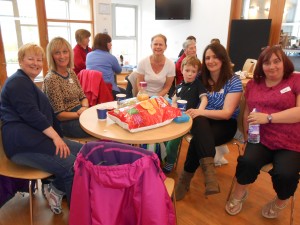 Originally planned for Pittencrieff Park, wet weather forced the picnic into Dunfermline East church instead. A great time was had by all
with the older children playing rounders and football; and the soft
play proving very popular with the younger children.
Face painting was also available - not
only for the children but some adults too!
Originally planned for Pittencrieff Park, wet weather forced the picnic into Dunfermline East church instead. A great time was had by all
with the older children playing rounders and football; and the soft
play proving very popular with the younger children.
Face painting was also available - not
only for the children but some adults too!
WAY is a national charity for those bereaved before their 51st birthday, either married, unmarried or gay, with branches all over the UK to enable young widows/widowers to support and advise each other through peer to peer support, online forums. The local groups hold regular meals, meet ups and outings.
For more information about the charity see www.widowedandyoung.org.uk, e mail to info@widowedandyoung.org.uk, or phone 0300 012 4929.
 RSS
RSS